
This week at RSA, Dave and I got to visit with the folks at Commvault. It’s clear that we’ve moved into the operational phase of securing AI, and I’m here for it!
The two things that stood out to me during our visit were Commvault’s focus on ResOps and Identity Resilience. Both of these topics are about resilience. The fundamental operational question they both answer is: Can the business continue to operate at an acceptable level when something goes wrong?
Commvault has focused on answering that question for clients.
Let me first start with the ResOps piece. When I think of ResOps, I think of a bridge between the security and IT Ops folks. By definition, ResOps is an evolution of cyber resilience that unifies security, identity management, and data protection into a single, automated, and continuous system. It transforms IT from “backup and restore” to “prevent, detect, and clean recovery.”
Modern threats move at machine speed; ResOps aims to mitigate risks from AI-powered attacks, ransomware, and complex hybrid-cloud failures that can crash systems in seconds.
In short, Resilience Operations (ResOps) is an operating model that is meant to close gaps.
AI Changes the Security Game
If we think about the traditional resilience model, we’d agree that it was designed for a static environment with an isolated recovery process. That model doesn’t bend so well when disruption occurs quickly across nontraditional environments like cloud, SaaS platforms, identity systems, and third-party services.
The data reflects a growing mismatch between operational complexity and resilience capability:
According to 2025 to 2026 industry reports, a significant majority of enterprises lack essential security practices for data and AI, with findings ranging from 77% to over 90%, depending on the specific metric.
Innovation is accelerating faster than most organizations’ ability to absorb disruption.
| Feature | Traditional DR/BCP | ResOps |
| Focus | System restoration | Service continuity |
| Approach | Reactive (after failure) | Proactive (continuous) |
| Data Integrity | Assume backup is clean | Verify data is uncompromised |
| Testing | Periodic, manual checklists | Continuous, automated simulations |
| Silos | Separate security & IT teams | Integrated teams & tools |
ResOps assumes disruption will occur. Preventative controls are just not sufficient.
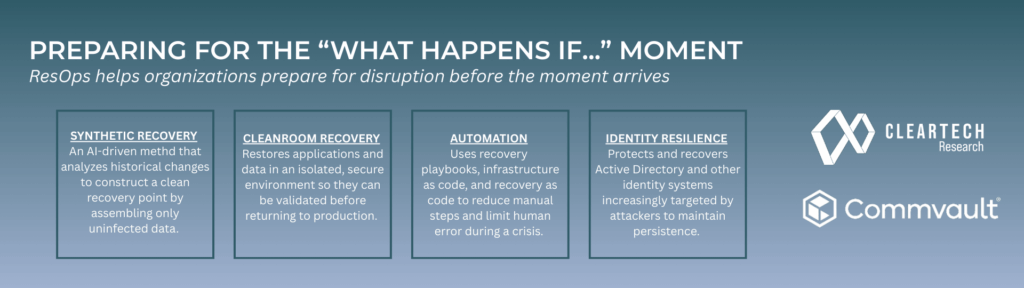
Commvault has built a portfolio of products that move the needle forward by focusing on solutions that prepare teams for that “What happens if….” moment. A few key technologies in their ResOps portfolio:
- Synthetic Recovery: An AI-driven method that analyzes historical changes to construct a “clean” recovery point by assembling only uninfected data, rather than rolling back to a previous, older state.
- Cleanroom Recovery: Restoring applications and data in an isolated, secure environment to validate them before reintroducing them to production.
- Automation: Using tools like infrastructure-as-code or recovery as code to automate recovery playbooks, removing the need for manual, error-prone human intervention during a crisis.
Identity Resilience: Protecting and recovering Active Directory and other identity systems, which are increasingly targeted by attackers to maintain persistence.
Why ResOps Matters to the Business
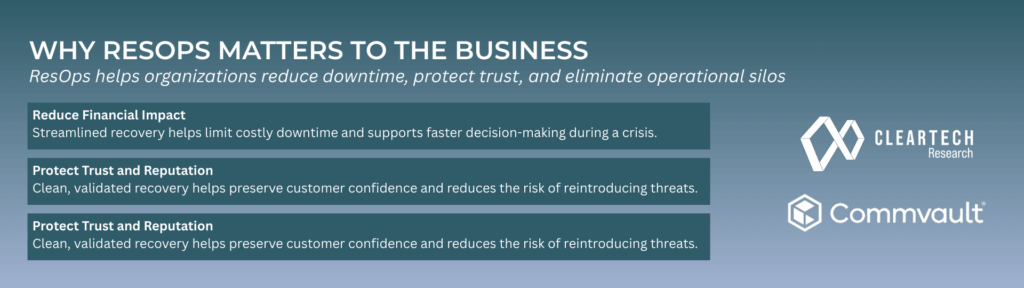
ResOps shifts the focus from individual technical assets to critical business services, ensuring that core functions remain operational even if some systems fail. There are 3 key areas that matter most:
Reduction of Financial Impact of Downtime:
- By streamlining recovery processes, ResOps helps businesses avoid the massive costs of prolonged downtime, which can exceed $300,000 per hour for many enterprises.
- It reduces the “cognitive load” on overstretched teams, allowing for faster decision-making during a crisis.
Protection of Trust and Reputation:
- The ability to recover quickly and cleanly preserves customer confidence, which is vital since over 80% of consumers may abandon a brand after a data breach.
- It validates that recovered data is complete and uncorrupted, preventing the re-entry of threats into the environment.
Elimination of Operational Silos:
- ResOps unifies disparate teams, Security (SecOps), Infrastructure (InfraOps), and Development (DevOps), under a shared goal of business resilience.
- This collaborative approach replaces “tribal knowledge” with tested, repeatable recovery operations.