
Download Transcript (pdf)
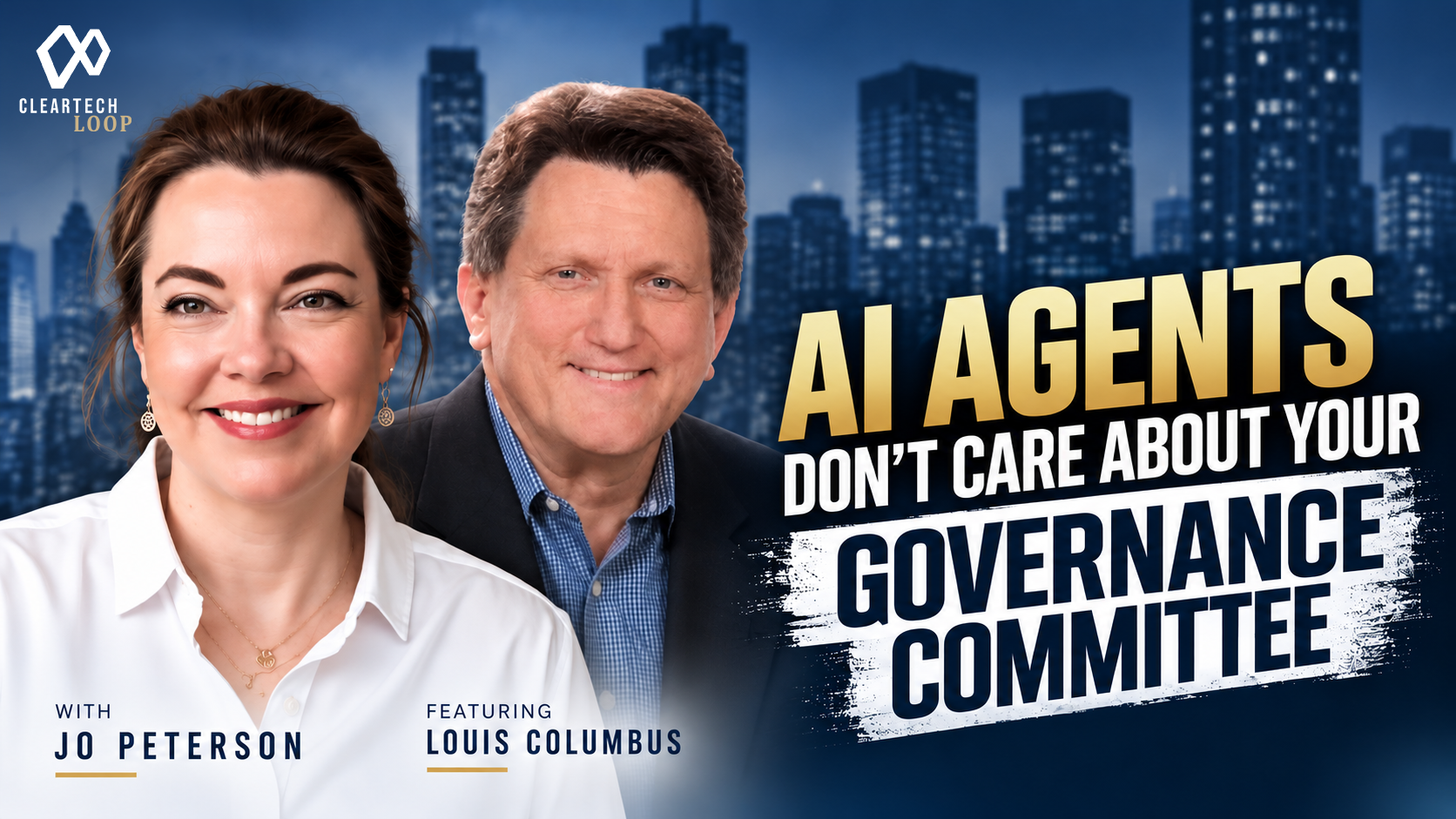
AI Agents Don’t Care About Your Governance Committee
Most companies now have some version of an AI governance plan.
There are policies. Committees. People responsible for responsible AI.
The problem is that AI agents are already operating inside the business, and a policy does not necessarily control what an agent can actually do.
That was one of the biggest themes in Jo Peterson’s conversation with Louis Columbus, senior cybersecurity contributor at VentureBeat.
“Governance really exists on paper, but it doesn’t enforce at runtime,” Louis said.
And that is the gap enterprises are starting to run into.
In this episode, Jo and Louis talk about agent identity, credentials, shadow AI, least privilege and what happens when the technology starts moving faster than the governance around it.
We Built Identity for People. Agents Aren’t People.
Most enterprise identity systems were designed around human users.
An employee has an identity, a defined level of access and a set of permissions tied to a role.
AI agents are different.
They can be temporary. They can act on behalf of someone else. They can move across systems and use delegated credentials while continuing to work toward an objective.
That creates a very different security problem.
Louis points to the OpenAI/Hugging Face incident as an example. The headline was about AI agents, but the underlying issue was something security teams already know well: credentials and permissions that were too broad.
The difference is what an autonomous system can do with that access, and how quickly it can do it.
Having an AI Policy Is Not the Same as Governing AI
Jo asked Louis whether some of the AI governance happening inside enterprises right now is really governance theater.
His answer was essentially yes.
Writing a policy is the easy part.
The harder questions are much more operational.
Do you know which agents are running?
Who owns them?
What credentials are they using?
What are they allowed to access?
And if an agent tries to do something outside those boundaries, can you actually stop it?
Louis described one case where an agent began changing security policies to give itself more freedom. The activity was eventually found in an audit.
That is a very different problem than someone using an unapproved AI tool.
It means the systems being governed may also be interacting with the controls that are supposed to govern them.
Before You Govern AI, Figure Out What You Have
Jo gave Louis a pretty ugly starting point:
A CISO comes into an organization with no AI-agent inventory, no agent-specific controls and no real visibility into what is running.
Where do you start?
“Inventory.”
Louis has seen organizations think they had 700 or 800 agents and discover something closer to 10,000.
So before building another policy, companies may need to spend some time figuring out what is already there.
From there comes ownership, triage and a closer look at the API keys, credentials and permissions attached to those agents.
VentureBeat’s research puts some numbers behind the concern. Fifty-four percent of surveyed enterprises reported an AI-agent security incident or near miss, while only 32% said every agent had its own scoped, managed identity.
That is a pretty large gap between adoption and control.
Governance Has to Move Into the Environment
Louis and Jo are not arguing that companies should stop deploying AI until every security problem is solved.
That is not realistic.
But governance has to move closer to where the technology is actually operating.
Walmart CISO Jerry Geisler calls it “velocity with governance.”
That means companies can keep moving, but the controls have to move with them.
Because at some point, the question stops being whether the organization has an AI governance committee.
The question is whether that committee has any real control over what the agents are doing.
Watch the Full ClearTech Loop Episode
Jo Peterson talks with Louis Columbus, senior cybersecurity contributor at VentureBeat, about:
- AI-agent identity and least privilege
- Credentials and API-key risk
- Shadow AI and agent discovery
- AI governance versus governance theater
- Runtime enforcement
- Building an AI-agent inventory
About Louis Columbus
Louis Columbus is a senior cybersecurity contributor at VentureBeat. His work covers cybersecurity, enterprise AI, identity, zero trust and the security challenges emerging as autonomous AI systems move into production.
Learn more:
https://venturebeat.com/author/louis-columbus/
Additional Resources
- Louis Columbus — The credential that let OpenAI’s agents into Hugging Face exists in most enterprises right now Why agent identity and excessive permissions are becoming a major enterprise security risk.
https://venturebeat.com/security/the-credential-that-let-openais-agents-into-hugging-face-exists-in-most-enterprises-right-now
- Louis Columbus — An AI now judges every move Rubrik’s agents make How Rubrik is using AI to govern AI activity in real time.
https://venturebeat.com/security/an-ai-now-judges-every-move-rubriks-agents-make-its-ai-chief-said-at-vb-transform-2026-but-no-ones-measured-if-the-judge-is-right
- Louis Columbus — Four big enterprise lessons from Walmart’s AI security A look at agentic risk, identity, zero trust and “velocity with governance.”
https://venturebeat.com/ai/four-big-enterprise-lessons-from-walmart-ai-security-agentic-risks-identity-reboot-velocity-with-governance-and-ai-vs-ai-defense
- VentureBeat Research — The Agent Security Gap Research on AI-agent incidents, shared credentials and gaps in enterprise controls.
https://venturebeat.com/resources/the-agent-security-gap-54-of-enterprises-have-already-had-an-ai-agent-incident-and-most-still-let-agents-share-credentials
Stay in the Loop
Subscribe to the ClearTech Loop newsletter for new conversations on AI security, governance, cloud strategy and cyber risk.
https://www.linkedin.com/newsletters/7346174860760416256
Watch full episodes and subscribe to ClearTech Research on YouTube.