
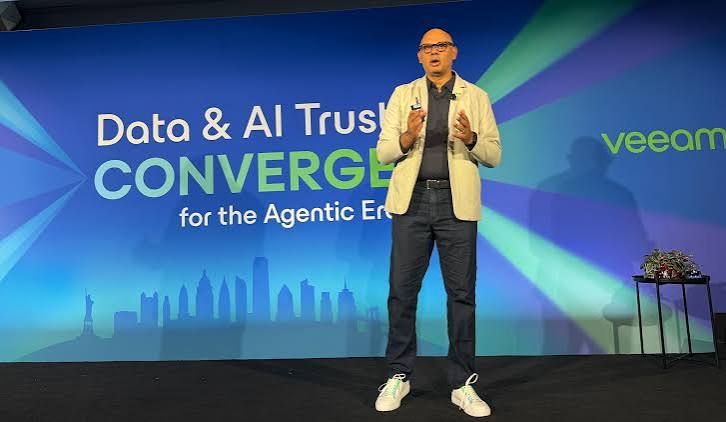
The VeeamON 2026 keynote focused on how trust—not technology—is the primary bottleneck for enterprise artificial intelligence, positioning Veeam as a foundational data and AI trust infrastructure layer.
October 15, 2026
📌 In case you missed it, the #VeeamON2026 keynote happened this morning at 10AM EST Anand Eswaran, CEO of Veeam Software delivered the keynote
Veeam highlighted its backing of over 550,000 customers globally (including 80% of the Fortune 500) and surpassing $2 billion in Annual Recurring Revenue.
The emphasis on trust over technology at VeeamON 2026 got me thinking about a shift that is happening in conversations I’m having with IT teams.
It seems that the primary barrier to enterprise AI scaling is no longer compute power or algorithmic sophistication, but rather data integrity, security, and the breakdown of traditional human-centric security perimeters.
So why has trust become so important?
Well there are 4 things that come to mind for me and Veeam did a good job speaking to all of them.
⭐ Autonomous Agents and Non Human Identities (NHIs)
⭐ Supply Chain Vulnerability
⭐ Ever Escalating Executive and Regulatory Liability
⭐ A Shift from Simple “BackUp” to Resilience Operations
Here’s the thing–legacy security, identity, and access management (IAM) models were built under the assumption that a human was ultimately driving actions.
The explosion of Agentic AI—autonomous agents executing complex workflows without real-time human intervention—breaks this model.
AI models are entirely dependent on the data they ingest. If an enterprises data is corrupted, poisoned, or unmapped dark data, the resulting AI outputs become a severe business liability.
Trusting the data supply chain means ensuring absolute data resilience.
The regulatory landscape has evolved from passive oversight to active enforcement of AI governance and algorithmic accountability. CISOs and executive leadership face direct liability for AI failures, data breaches, and non-compliance.
Technology alone cannot solve this; enterprises require a structured trust infrastructure As cyber threats like ransomware specifically target backup repositories to force payouts, technology alone (simply having a backup file) is insufficient.
Trust is achieved through Resilience Operations (ResOps)—the continuous, automated validation that data is clean, compliant, and rapidly recoverable.
What do you think? Has the conversation shifted away from technology to trust?